

Most small businesses only learn they’ve hired the wrong web designer after the deposit is paid. The warning signs are almost always there before you sign — they’re just easy to miss when a proposal looks good and you want to move forward. The good news is that the riskiest patterns are remarkably consistent, and once you know what they look like, they’re easy to spot.
This guide covers the biggest red flags when hiring a web designer or agency, in roughly the order they tend to surface: ownership and access, pricing and scope, promises and proof, and communication. It’s written for Australian small business owners who are comparing freelancers, studios and agencies and getting close to the quote-and-contract stage. If you’re still earlier in the process, start with our complete guide to how to choose a web designer; this article is the risk-spotting companion to that.
Key Takeaways
- The biggest red flags involve control: a designer who holds your domain, hosting or admin access, or who can’t explain what you’ll own when the project ends.
- A vague quote and a missing contract predict surprise costs and scope disputes far better than a low price does.
- Anyone who guarantees #1 Google rankings is promising something Google itself says can’t be guaranteed — a reliable signal to walk away.
- Judge work by live websites you can test on your phone, not screenshots; a designer with no verifiable work has a reason.
- Pre-sale communication is the best version of how they’ll communicate later. If it’s already hard to get straight answers, it won’t improve after you pay.
The Quick Answer
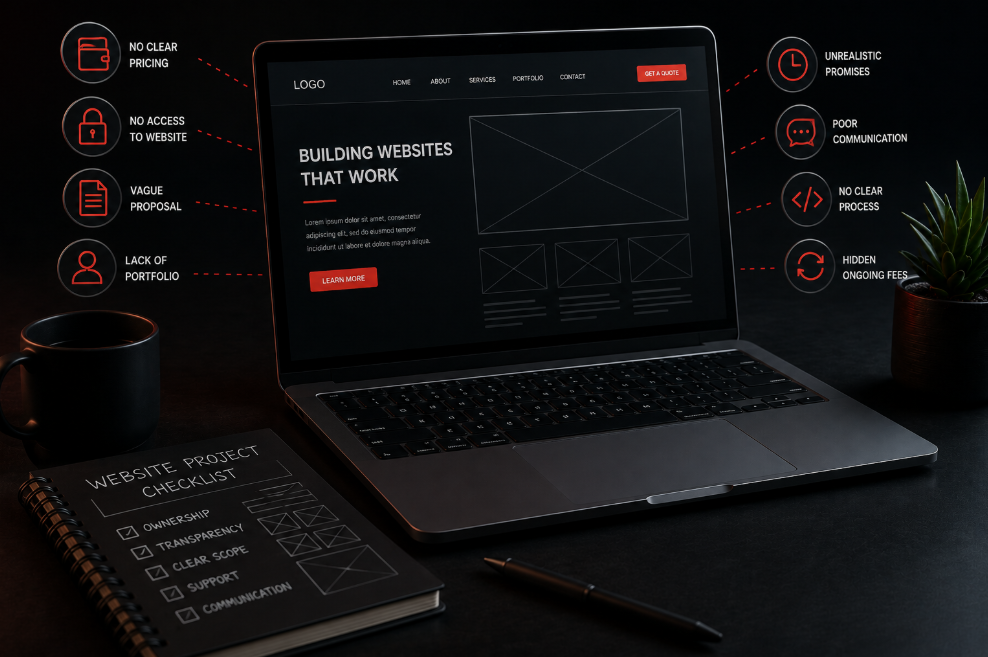
If you want the short version: the biggest red flags when hiring a web designer are a designer who won’t give you ownership or admin access, can’t explain what you’re paying for, guarantees #1 Google rankings, has no verifiable portfolio, avoids talking about ownership, won’t put the scope in a contract, quotes suspiciously low prices without explanation, pushes a platform without reasoning, communicates poorly before you’ve paid, or can’t explain what happens after launch. Any one of these is worth probing. Several together should end the conversation.
Below, each warning sign is explained with what to look for and the exact question to ask instead. There’s a printable checklist at the end, and a note on what Australian law does and doesn’t guarantee — because practical guidance is not the same as legal advice.
1. They Won’t Give You Website or Admin Access
The single most common way small businesses get burned is discovering, sometimes years later, that they can’t get into their own website. If your designer registers the domain in their name, hosts the site on their account, and keeps the CMS login to themselves, you don’t actually own your online presence — you’re renting it on their terms.
What you should control from day one: the domain (registered in your name, not theirs), the hosting account, CMS admin access (WordPress, Shopify, or whatever platform), and the business accounts — Google Analytics, Google Search Console, and any other tools your site depends on. This isn’t about mistrust; it’s about basic hygiene. A professional will set all of this up in your name and hand over the keys as part of the process.
What to ask instead: “Will the domain be registered in my name, will the hosting account be mine, and will I have full admin access from day one — or only after final payment?” If the answer is anything other than a clear “yes, yours,” that’s a red flag. One useful check in Australia: look the domain up in the auDA WHOIS tool — for a .com.au domain, the registrant should be your business or a person authorised to hold it on your behalf, not the designer.
2. They Can’t Clearly Explain What You’re Paying For
A vague quote is a promise of surprise charges. If a proposal says “website design — $4,500” and nothing more, you have no way to know whether copywriting, images, SEO basics, revisions, hosting or training are included — and every one of those can resurface later as an extra cost.
A good proposal tells you three things plainly: what is being built (pages, features, integrations), what is included (content, images, setup, training), and what costs extra (revisions beyond the included rounds, ongoing maintenance, add-ons). If any of the three is missing or vague, ask for it in writing before you commit. Recurring fees deserve particular attention — hosting, maintenance, or “care plan” subscriptions should be itemised with their own price, not folded into a number you can’t unpack.
What to ask instead: “Can you break down what’s included and what costs extra, in writing?” A designer who hesitates here is telling you something about how the project will go.
3. They Promise Guaranteed #1 Google Rankings
No one can guarantee a #1 Google ranking, and anyone who promises one is either misleading you or planning to game the system. Google’s own SEO guidance is explicit on this — the company states plainly that there are “no secrets here that’ll automatically rank your site first in Google,” that there’s no guarantee any particular site will even be indexed, and that improvements can take months with no certainty of visible impact (Google’s SEO Starter Guide, retrieved August 2026).
Rankings depend on competition, content, authority and time — none of which a web designer controls. What a legitimate provider can honestly say is “we’ll do the work that gives you the best chance,” with realistic timelines. Beyond being unrealistic, a guaranteed-ranking claim is the kind of promise that can trip over the Australian Consumer Law, which prohibits businesses from making false or misleading claims about what their services can achieve (ACCC, False or misleading claims, retrieved August 2026).
What to ask instead: “What results have you delivered, over what timeframe, and what’s realistic for my market?” The answer to that is far more informative than any guarantee.
4. They Have No Real Portfolio or Verifiable Work
A designer’s past work is your best evidence of future results — which is exactly why a missing or unverifiable portfolio is a serious warning sign. Be wary of a portfolio that is only screenshots, only mockups, or only descriptions of work “under NDA.” Real websites are public, and a legitimate designer can point you to live sites you can open and test yourself.
Test their work the way a customer would: open each site on your phone, not just a desktop. Does it load quickly? Is the message clear in a few seconds? Is it easy to find contact details and take the next step? A portfolio of live, working sites that perform well tells you far more than a folder of pretty images. And don’t just look at the sites — ask whether they were built recently, by the person you’re talking to, and whether you can speak to a past client.
What to ask instead: “Can you show me three live websites you built in the last year, ideally for businesses like mine?” If they can’t, that’s the answer. For a deeper framework on reading portfolios, our guide on how to evaluate a web design portfolio walks through exactly what to check.
5. They Avoid Talking About Ownership
Ownership is not a technicality — it’s the difference between having a website and borrowing one. The things you should own (or have clear, documented rights to) include: the domain name, the website files and code, the CMS, the content and copy, the design assets (logos, graphics, layouts), and clarity on third-party licences (fonts, images, plugins).
The right time to settle ownership is before you sign, in writing — not after the project ends and the designer moves on. This is practical guidance, not legal advice: the details of copyright and licensing can depend on the specific agreement, which is precisely why it belongs in your contract. What you should never accept is a designer who waves the question away or says “don’t worry, I’ll handle all that.”
What to ask instead: “Can you confirm in the contract that I’ll own the finished website, its content, and the design assets, and that any third-party licences will be transferred to me?” For more on the mechanics, our guide to website ownership, domains and hosting covers the practical steps to stay in control.
6. There Is No Clear Contract or Scope
A website project without a written contract is a project with an unresolved argument in its future. If a designer wants to start on a verbal agreement, an informal email, or a one-page invoice with no detail, that’s a red flag — not because all verbal arrangements fail, but because the ambiguity is where cost overruns and disputes live.
A proper contract or written scope should cover: the scope of work and deliverables, revision limits (how many rounds, what counts as a change), payment milestones, timeline, cancellation terms, ongoing maintenance (what it costs, what it includes), and ownership and handover — who gets what when the project ends. Australian law backs you up at a basic level: under the Australian Consumer Law, services must be provided with due care and skill, be fit for the purpose you made known, and be delivered within a reasonable time (business.gov.au’s ACL guidance, retrieved August 2026). But a written agreement resolves the details the law doesn’t reach, so insist on it.
What to ask instead: “Can I see a sample contract or a written scope before we start?” A professional will have one ready. Our upcoming web design contract guide will walk through the clauses that protect you, clause by clause.
7. The Price Is Suspiciously Cheap — Without an Explanation
Cheap alone is not a red flag. A modest budget can buy a perfectly good simple website, and honest designers work at every price point. The red flag is a price that is dramatically below market with no explanation of how — no mention of templates, no limits on revisions, no clarity on who writes the copy, no note on hosting, SEO or maintenance.
When a $500 quote sits next to typical market pricing, the difference isn’t a discount — it’s a difference in what’s being delivered. It may be a template with your logo dropped in, content you’ll have to write yourself, no mobile optimisation, no security setup, or an upsell funnel where every essential is an add-on. None of that is inherently wrong if it’s stated; what’s wrong is a price presented as “full service” when it can’t be.
What to ask instead: “At this price, what exactly do I get — and what don’t I get?” A straight answer tells you whether the deal is honest or misleading. For a sense of what typical Australian prices buy, our Adelaide web design cost guide breaks down realistic ranges and what they include.
8. They Push You Into a Platform Without Explaining Why
Every platform — WordPress, Shopify, WooCommerce, custom development — is a tool, and the right one depends on your business. A designer who insists on one without explaining why may simply be more comfortable in it, or may be steering you toward something that suits them rather than you.
The platform decision affects your ongoing costs, your ability to update the site yourself, and how easily you can move to another provider later. A good designer will explain the trade-offs in plain terms: why this platform fits your catalogue, your budget, your team’s skill level, and your growth plans — and what you’d give up by choosing differently. If the answer is “this is what we use,” that’s not an answer.
What to ask instead: “Why is this platform right for my business specifically — and what are its downsides?” For the two most common Australian choices, our honest Shopify vs WooCommerce comparison lays out the real trade-offs.
9. Communication Is Already Poor Before You Pay
The way a designer communicates before you sign is the best-case version of how they’ll communicate during your project. Before payment, they’re at their most motivated — if you’re already getting vague answers, missed commitments, disappearing messages, or decisions that never get confirmed in writing, none of that will improve after you’ve paid.
This isn’t about expecting rapid-fire replies to every message. It’s about the quality of the communication that matters: clear answers to direct questions, commitments you can rely on, and a willingness to document decisions. Pre-sale is when a designer is trying hardest to win you; if the effort isn’t there now, the project will be harder to manage, not easier.
What to ask instead: Nothing — this is about observation. Notice how they respond to your questions and whether they follow through on small promises. The pattern is the signal.
10. They Can’t Explain What Happens After Launch
Launch day is not the end of your website’s life — it’s the start. Software updates, security patches, backups, hosting, content changes and occasional fixes are all ongoing realities, and a designer who can’t tell you how those are handled is leaving you to discover the gaps the hard way.
Ask specifically: who is responsible for maintenance and updates, backups, security, hosting, and support after launch? Is there an ongoing fee, and what does it cover? Can you make content changes yourself, or does every edit go through the designer? A clear answer means predictable costs and no surprises. A vague “we’ll look after it” with no detail is a red flag — and so is an unexplained monthly charge that appears only after the project is done.
What to ask instead: “What happens after launch — who handles updates, backups and support, and what does it cost?” Get the answer in writing.
Key Takeaway: Most web design disasters share one root cause: ambiguity. Ownership, scope, price, platform and after-launch support are all negotiable — what’s unacceptable is a designer who won’t put any of them in writing. A trustworthy designer welcomes clear questions because the answers are good for their business too.
Web Designer Red Flag Checklist
Before you pay a deposit or sign anything, run through this checklist. A “no” or a vague answer on any line is worth probing; several “no”s is a strong signal to walk away:
| Check | What to look for |
|---|---|
| Who owns the domain? | Registered in your name (check WHOIS for .com.au), not the designer’s |
| Who controls hosting? | The hosting account is yours, or you’ll have full access |
| Will you receive admin access? | CMS, analytics and Search Console access from day one |
| What exactly is included in the quote? | Pages, features, content, images, training — itemised |
| What costs extra? | Revisions, add-ons, hosting, maintenance — priced up front |
| Who owns the final website and assets? | You do, confirmed in the contract |
| What happens if the project stops? | Cancellation terms and what you keep are written down |
| What happens after launch? | Maintenance, backups, security, support — clear and costed |
| Are recurring fees clearly explained? | Every ongoing charge itemised before you sign |
| Can you verify previous work? | Live websites you can test on your phone, and a client reference |
A Note on Your Legal Position (Not Legal Advice)
A few things are worth knowing about where Australian law stands, without this being legal advice. Under the Australian Consumer Law, services must be provided with due care and skill, fit for the purpose you made known, and delivered within a reasonable time — and these guarantees can’t be signed away (ACCC, Australian Consumer Law and your business, retrieved August 2026). Businesses are also prohibited from making false or misleading claims about their services, including promises they can’t keep (ACCC, False or misleading claims).
But the law mostly sets the floor — the specifics of ownership, scope and handover are determined by your contract. That’s why the checklist above, and getting everything in writing, matters more than knowing your rights after the fact. If a dispute does arise, remedies exist, but they’re slower and more stressful than a clear contract was. If you’d like to compare how a serious, contract-first web team works, you can see exactly what’s included in our website development services and what it costs on our transparent pricing page.
Frequently Asked Questions
What are the biggest red flags when hiring a web designer?
The biggest red flags are: a designer who won’t give you ownership or admin access to your domain, hosting and website; a vague quote that doesn’t say what’s included; a promise of guaranteed #1 Google rankings; no verifiable portfolio; avoidance of ownership questions; no written contract; suspiciously low pricing with no explanation; and poor communication before you’ve paid. Any one deserves probing; several together should end the conversation.
How do I know if a web designer is legitimate?
A legitimate designer shows you live websites you can test on your phone, names past clients you can speak to, puts the scope and price in writing, confirms you’ll own your domain and website, and answers ownership and after-launch questions clearly. They welcome scrutiny because they have nothing to hide — and they don’t guarantee rankings no one can guarantee.
Should my web designer own my domain?
No. Your domain should be registered in your name or your business’s name from the start. If a designer registers it in their name, you’re dependent on them for your online identity — and if the relationship ends, getting it back can be difficult. For a .com.au domain, the auDA WHOIS lookup shows who the registrant is; it should be you.
Should I get admin access to my website?
Yes — full admin access to your CMS, hosting and analytics should be yours from day one, not held hostage until final payment. You don’t have to use it, but you should be able to. A designer who insists on being the only one with access is creating dependency, not protecting you.
Should I pay a web designer upfront?
Reasonable deposits are normal — often a percentage to secure the booking, with the balance tied to milestones. What’s a red flag is a demand for full payment upfront, or payment before you’ve seen a written contract. Milestone-based payment protects both sides and is the professional norm.
How do I check a web designer’s portfolio?
Open their live websites on your phone and test them like a customer: load speed, clear message, easy contact details, working next steps. Ask when the sites were built, whether the person you’re talking to did the work, and whether you can speak to a past client. Screenshots and mockups are not proof of work.
