

The questions you ask a web designer before you sign decide the quality of the project more than almost anything else. A good designer will welcome them all — the answers are what separates a smooth project from an expensive lesson. The trouble is knowing which questions matter, and what a good answer sounds like.
This guide gives you the full list, organised by the order they surface in a real hiring conversation, with the practical detail that makes each one useful. It’s written for Australian small business owners in the shortlist-to-contract stage, comparing freelancers, studios and agencies. If you’re earlier in the journey, start with our complete guide to how to choose a web designer; and if you’re looking for warning signs to watch for while they answer, our guide to web designer red flags covers the observation side of the same conversation.
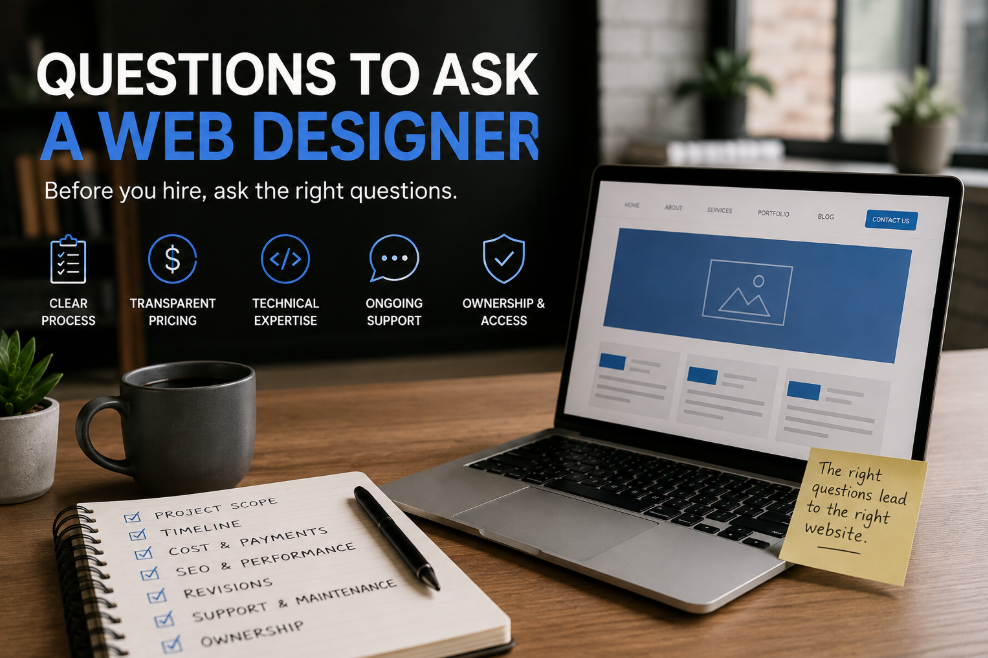
Key Takeaways
- Ask questions that reveal how the designer works, not just what they charge: process, scope, ownership, revisions, timeline and support.
- The three highest-value questions are: what exactly is included, what costs extra, and who owns the website, domain and accounts when it’s finished.
- A good answer names specifics — deliverables, limits, dates — while a concerning answer stays vague or promises outcomes no one can guarantee.
- In Australia, paying for a website does not automatically transfer its ownership — the contract determines who owns the IP unless it says otherwise (IP Australia).
- Deposits and milestone payments are normal; what matters is that the payment structure, scope and deliverables are all clear in writing before you commit.
The Quick Answer
The questions to ask a web designer before hiring fall into four groups: experience (have you built sites like mine, can I see live work), scope and price (what exactly is included, what costs extra, why this platform), ownership and control (who owns the website, domain and accounts, what access do I get, what happens if I leave), and process and support (revisions, timeline, what you need from me, SEO, performance, security, what happens after launch, ongoing fees, and how results are measured). Ask questions from each group before you sign anything — and measure the answers as much as the words.
1. Have You Built Websites Like Mine Before?
You’re not looking for a designer who has worked with your exact industry — you’re looking for evidence they understand the kind of problem your website solves. A designer who has built enquiry-generating sites for tradespeople understands what a plumber needs even if they’ve never built for your specific trade; one who has only built brochure sites may not.
Ask what kinds of businesses they’ve built for, whether they’ve handled your type of project (ecommerce, bookings, lead generation, bilingual content), and how those projects went. The answer tells you whether they’ll ask you useful questions or start talking about colours and fonts.
2. Can You Show Me Live Websites You Actually Built?
Screenshots are not evidence of work. Ask for live websites, then test them the way a customer would — on your phone, not your desktop. Does the site load quickly? Is the message clear in seconds? Is it easy to find contact details and complete the main action, whether that’s calling, booking or buying?
Also ask what they personally did on the project and when it was built. A designer who can’t point to recent, relevant work they did themselves is harder to evaluate honestly. For a deeper framework on judging portfolios, our guide on how to evaluate a web design portfolio walks through exactly what to check — it’s due to be published separately.
3. What Exactly Is Included in the Quote?
This is the single most important question on the list, and it deserves to be asked in writing. A good proposal tells you precisely what’s being built — number of pages, design, development, forms, integrations, ecommerce — and what’s included in that: copywriting, images, SEO basics, analytics setup, hosting, revisions, training and launch support.
If the answer to “what’s included” is “everything,” that’s not an answer — it’s a promise that will meet the invoice later. The measure of a good quote is its specificity: named deliverables, page counts, included content, and a clear line between what’s in and what’s out.
4. What Will Cost Extra?
This question matters just as much as the last one, and it’s worth asking separately. A healthy answer names the optional costs: extra pages beyond the included scope, additional revision rounds, premium themes or plugins, stock photography, copywriting, integrations, domain registration, hosting, maintenance, and urgent changes after launch.
The distinction that matters: unexpected cost is the problem; clearly disclosed optional cost is normal business. A designer who lists their add-ons up front is being honest about how projects work. A designer who says “that’s all included” with no scope to back it up is either about to charge you later or is underestimating the project — neither is good.
5. What Platform Will You Build My Website On — and Why?
WordPress, Shopify, WooCommerce, a website builder, custom development — every option has trade-offs, and the right one depends on your business, not the designer’s comfort zone. Ask why they recommend this platform for your requirements: how it handles your catalogue or booking flow, what it will cost ongoing, how easy it is for your team to update, and what you’d give up by choosing differently.
A designer who explains trade-offs is choosing for your situation; one who says “this is what we use” is choosing for themselves. For ecommerce businesses, our honest Shopify vs WooCommerce comparison lays out the real differences in Australian terms.
6. Who Will Own the Website, Domain and Accounts?
This is the question that protects you years from now. When the project finishes, you should know exactly who owns: the domain name, the hosting account, the website and its code, the content and copy, the design assets, and the accounts your site depends on — Google Analytics, Search Console, Google Business Profile, ecommerce and payment accounts.
Here’s the part most business owners don’t know: in Australia, paying for a website does not automatically transfer its ownership to you. IP Australia’s guidance states that IP created by a contractor belongs to the contractor unless the contract says otherwise — so the written agreement is what determines who owns what, and that’s exactly why this belongs in the contract, before work starts (IP Australia, “Who owns intellectual property?”, retrieved August 2026). This is practical guidance, not legal advice — the specifics depend on your agreement, which is the point.
7. Will I Have Full Admin Access?
Ask what access you’ll receive and when: CMS admin, hosting, domain registrar, analytics, Search Console, and ecommerce accounts. The honest answer may vary by technical setup — a developer may hold certain credentials for security or support reasons — but you should know up front what you can access, what you can’t, and why.
The concerning pattern is not a designer holding a credential for a reason; it’s a designer who won’t explain what you’ll have, or who plans to give you access only after final payment. Your website is your business asset — plan to have the keys, even if you don’t use them often.
8. How Do Revisions Work?
Revisions are where many projects quietly go wrong, because “a few changes” means different things to different people. Ask: how many revision rounds are included, what counts as a revision (a tweak vs a new section), when feedback is expected, what happens after the included rounds, and whether major scope changes are priced separately.
There’s no industry-standard number of revisions, so treat any specific figure as that designer’s policy rather than a norm. What matters is that the policy is stated before you sign, not discovered at the first change request.
9. What Is the Expected Timeline?
Ask for the project stages and expected dates — design, build, content loading, testing, launch — and be clear about what depends on you. Most website projects are co-produced: the designer can’t finish until you’ve supplied content, approved designs and answered questions. Knowing the dependency points up front tells you whether the timeline is realistic and what your responsibilities are.
A good answer names specific stages with dates and who does what at each. A vague “we’ll be in touch when it’s done” is the answer to run from. It’s also worth asking what happens if either side causes delay — a professional will have a policy, not a surprise.
10. What Do You Need From Me?
This question is overlooked in most checklists, and it’s one of the most practical. A website project requires inputs from you: your logo and branding, photos, copy, product or service information, legal content (privacy policy, terms), feedback and approvals, and access to accounts.
Asking this up front tells you what the project will demand of your time — and it reveals how organised the designer is. A designer who can hand you a clear list of deliverables-from-you at the start is a designer who has run projects before. If the answer is “just give us the content when it’s ready,” you’re being set up for delays and scope creep.
11. What SEO Is Included?
This question deserves precision, because “SEO” means very different things. There’s basic website SEO setup — page titles, meta descriptions, heading structure, crawlability, an XML sitemap, mobile usability and performance basics — which should reasonably be part of building a website properly. And there’s ongoing SEO — keyword strategy, content production, link building, local SEO and ongoing optimisation — which is a separate, ongoing service with its own cost.
Ask which of the two is included in your quote, and what the ongoing version would cost. Critically, set your expectations: buying a website does not automatically get you Google rankings. Rankings come from ongoing work and time. For a realistic picture of what that ongoing work costs, see our guide to SEO costs in Australia, and our digital marketing services explain how the two layers fit together.
12. How Will You Handle Website Performance?
A beautiful website that loads slowly is a beautiful website nobody visits. Ask how they handle image optimisation, mobile performance, code and plugin choices, and hosting. Google’s own Core Web Vitals guidance defines the practical targets — Largest Contentful Paint, Interaction to Next Paint and Cumulative Layout Shift — and any designer building properly in 2026 should be able to speak to these without being prompted (Google, retrieved August 2026).
What you should not ask for is a promise of a specific PageSpeed score — scores vary by testing tool, device and network, and any designer who guarantees one is overselling. The question to ask is how they build for performance and how they verify it, not for a number.
13. How Will You Make the Website Mobile-Friendly?
”Responsive design” is table stakes in 2026 — the useful question is how they handle the mobile experience specifically: navigation on a small screen, forms that are easy to fill on a phone, tap targets that aren’t fiddly, content that doesn’t demand endless scrolling, and a checkout or booking flow that works one-handed. Most of your customers will visit on their phone, so this is where your conversion actually happens.
Test the live sites they showed you earlier on your own phone — if their portfolio feels awkward on mobile, your site will too.
14. How Do You Handle Security and Backups?
Ask how they handle updates, backups, SSL certificates and plugin or theme maintenance — and for ecommerce sites, payment security and account protection. The right answer depends on the platform: a hosted platform like Shopify handles much of this for you, while a self-hosted site like WordPress makes it your (or your maintainer’s) responsibility.
Keep expectations accurate: an SSL certificate encrypts the connection between the visitor and your site — it’s an important baseline, but it isn’t a guarantee the site can’t be compromised. The practical questions are who keeps the site updated, how often backups happen, and where they’re stored.
15. What Happens After the Website Launches?
Launch day is the start, not the finish. Ask what happens in the weeks after launch: handover and training, a bug-fix period, and who’s responsible for ongoing updates, security, backups, hosting and support — and what each costs. This is also where you learn the difference between a project (designing and building the site) and an ongoing service (keeping it healthy and improving it), which are usually sold separately.
A designer who can’t explain what happens after launch hasn’t thought past it — and that’s where your site will live for years.
16. Are There Any Ongoing Fees?
Every website has ongoing costs, and they should all be named before you sign: hosting, domain renewal, maintenance, plugin or app licences, ecommerce platform fees, and support retainers. For ecommerce, the platform fee is a predictable monthly cost — our Shopify store cost guide breaks down how those add up in Australian dollars, and our platform comparison shows how they differ between Shopify and WooCommerce.
The question isn’t whether ongoing costs exist — they always do. The question is whether they’re disclosed up front, itemised, and reasonable for what you’re getting.
17. What Happens If I Want to Leave?
This is the highest-value question most people never ask: if the relationship ends, can the site be transferred? Ask who holds the domain and hosting access, whether the site and its content can be exported, whether paid themes or plugin licences are transferable, and how the handover process works. The answer should be in the contract, not improvised at the exit.
You don’t need to plan to leave — you need to know you can. A designer who’s confident in their work is confident in your ability to walk away. For more on staying in control of your online assets, our guide on website ownership, domains and hosting covers the practical side (due to be published separately).
18. How Will We Measure Whether the Website Is Working?
End the conversation with outcomes. Ask how you’ll know the website is doing its job: enquiries, calls, bookings, sales — the actions that matter for your business — and how they’ll be tracked. Analytics setup (Google Analytics, Search Console, and platform analytics for ecommerce) should be part of the project, and you should know what you’ll be able to see and when.
This question shifts the conversation from buying a website to investing in a business asset — and a designer who engages with it is thinking about your results, not just their deliverable.
Key Takeaway: A designer’s answers to these questions are more revealing than their portfolio. Specific answers about scope, cost, ownership and support predict a smooth project; vague answers predict surprises. And the questions that protect you most — what’s included, what costs extra, who owns what — are the ones worth asking in writing, before you pay a deposit.
Questions to Ask a Web Designer: The Checklist
Take this condensed checklist to your next consultation. Fourteen questions, grouped the way they’ll surface in the conversation:
- ☐ Can you show me live websites you built for businesses like mine — and can I test them on my phone?
- ☐ What exactly is included in the quote — pages, design, content, images, SEO basics, analytics, training?
- ☐ What will cost extra — and is every optional cost named up front?
- ☐ Why is this platform right for my business specifically, and what are its trade-offs?
- ☐ Who will own the domain, hosting, website, content and design assets when it’s finished?
- ☐ What admin access will I receive, and when?
- ☐ How many revision rounds are included, and what counts as a revision?
- ☐ What is the timeline — and what will you need from me at each stage?
- ☐ What SEO is included in the build, and what would ongoing SEO cost separately?
- ☐ How will you handle performance, mobile experience, security and backups?
- ☐ What happens after launch — support, maintenance, handover, and what each costs?
- ☐ What ongoing fees should I expect — hosting, domains, plugins, platform fees?
- ☐ What happens if I want to move to another provider?
- ☐ How will we measure whether the website is working — and how will results be tracked?
How to Evaluate the Answers
Asking the questions is only half the job — the other half is knowing what a healthy answer sounds like. Use this as your gauge:
| Question area | A good answer includes | Follow up if… |
|---|---|---|
| Ownership and access | Clear, specific: what you own, what you can access, when | …the answer is vague, or access comes only after final payment |
| Pricing and scope | Named inclusions and exclusions, with deliverables | …“everything is included” comes with no scope to back it up |
| Platform choice | Reasoning tied to your business, with honest trade-offs | …the answer is “this is what we use for everyone” |
| Timeline | Named stages, dates and who does what at each | …the answer is “we’ll be in touch when it’s done” |
| Revisions | A stated number of rounds and what counts as a change | …revisions are “unlimited” with no definition of a revision |
| Post-launch support | A clear arrangement: handover, support, maintenance, costs | …there’s no explanation of what happens after launch |
| SEO and results | Honest expectations about timelines and what’s included | …they promise rankings or outcomes no one can guarantee |
Notice how the same pattern runs through every row: specificity is the signal. If you’d like to see how we’d answer these questions ourselves, our website development services and transparent pricing are set up to make every answer checkable — and if we’re not the right fit, we’ll say so.
A Note on Deposits and Payment
You’ll hear varying advice about paying a web designer upfront, and the honest answer is nuanced. A deposit is common and reasonable — it reserves the designer’s time and covers early work. What’s worth caution is not the deposit itself but the pattern around it: a large payment demanded before you’ve seen a written scope, a payment schedule with no milestones, or full payment required before any defined deliverable. That arrangement places most of the risk on you.
The healthy version is a staged schedule tied to documented stages — discovery, design approval, development, testing, launch — so both sides are protected as the work progresses. Under the Australian Consumer Law, services must be provided with due care and skill and within a reasonable time (business.gov.au’s ACL guidance, retrieved August 2026) — but a clear written agreement is what makes any dispute unnecessary in the first place. This is practical guidance, not legal advice.
Frequently Asked Questions
What questions should I ask a web designer before hiring them?
The highest-value questions are: what exactly is included in the quote, what will cost extra, who owns the website and domain when it’s finished, what admin access you’ll receive, how revisions work, what the timeline is, what SEO is included, what happens after launch, and what happens if you want to leave. Specific answers predict a smooth project; vague answers predict surprises.
How do I know if a web designer is good?
Ask to see live websites they built for businesses like yours, and test them on your phone. Then judge the conversation: a good designer asks questions about your business, gives specific answers about scope and pricing, explains platform choices in terms of your needs, and welcomes ownership and support questions. Specificity across those answers is the strongest signal.
Should I pay a web designer upfront?
A reasonable deposit is normal — it reserves the designer’s time. What warrants caution is a large payment before you’ve seen a written scope, or full payment before any defined milestone. A staged schedule tied to documented stages — discovery, design approval, development, launch — protects both sides, and everything should be in writing first.
Who should own my domain and website?
You should — but in Australia, paying for a website doesn’t automatically transfer ownership to you. IP Australia’s guidance is that IP created by a contractor belongs to the contractor unless the contract says otherwise. That’s why ownership of the domain, website, content and design assets must be written into the agreement before work starts.
What should be included in a web design quote?
A good quote names the deliverables — pages, design, development, forms, integrations — plus what’s included (content, images, SEO basics, analytics, training) and what costs extra (additional revisions, premium plugins, stock photos, maintenance). If a quote says “everything included” with no scope, it’s not a quote yet.
How many revisions should a web designer provide?
There’s no industry-standard number — it varies by designer, project and price. What matters is that the number of included rounds, and what counts as a revision, are stated in writing before you sign. After the included rounds, additional changes are typically priced separately, and that policy should also be clear.
What happens after my website launches?
After launch you should expect handover and training, a defined bug-fix period, and clarity on who handles ongoing updates, security, backups, hosting and support — and what each costs. Distinguish the project (building the site) from the ongoing service (keeping it healthy), and agree on both before you start.
